Email marketing is still one of the main communication pillars for many brands. It works, it scales, and it continues to deliver results.
But why limit yourself to always doing the same thing?
Your customers naturally move across channels. They open an email about your sale, browse your website looking for the perfect product, and compare prices in your physical store. They don’t experience these as separate moments, but as one single experience with your brand.
And that’s the key!
It’s not about squeezing every last drop out of one channel or flooding your customers’ inboxes. It’s about opening up to other channels that complement what already works and enrich the shopping experience, wherever the customer happens to be.
So this article isn’t here to tell you to abandon email.
It’s here to give you context, ideas, and inspiration to understand why omnichannel is now a real necessity, and why you should consider opening up new channels that help you connect better with your customers when email can only go so far.
Because customers no longer think in terms of channels. They think in terms of brands that know when and how to show up.
And that’s where the real challenge begins.
Omnichannel: connecting channels, not multiplying them
Let’s clear this up from the start: omnichannel doesn’t mean being everywhere.
When a brand is present on multiple channels but each one operates independently, with its own messages and goals, that’s multichannel. The result is often a fragmented experience that’s hard to scale and, many times, noisier than it is effective.
Omnichannel goes in the opposite direction. It happens when an eCommerce business stops thinking in isolated campaigns and starts seeing the customer as a whole.
Channels are connected, information flows between them, and the experience is built continuously. The message adapts to the moment and the context, no matter which channel it comes through.
One channel for each goal? Yes, you can!
Within this vision, email marketing remains a key piece. It’s a solid channel for storytelling, delivering value, and building your brand.
But it’s also one of the most demanding: writing and reviewing copy, designing creatives, building the email, tweaking subject lines, taking care of deliverability, testing… all that work to often achieve results very similar to last year’s.
This isn’t about questioning email or taking value away from it. It’s about asking an honest question: how far can it go on its own?
In an omnichannel strategy, each channel plays a specific role and serves a different purpose. Let’s look at a few examples.
Email marketing is ideal for storytelling. At Ona Llibres, for instance, the welcome email isn’t designed to sell straight away. It’s an opportunity to get to know the brand, its values, its cultural offering, and to start a relationship based on connection with readers.
The website, on the other hand, is where conversion happens. Xiaomi Store has this crystal clear: they design upselling strategies by showing products similar to what customers are viewing, but with higher value. That well-applied personalization has translated into a 30% increase in average order value. Impressive, right?
Push notifications are great for creating urgency. At Powerplanet, they’re used to speed up purchase decisions by communicating discounts and free shipping. A seemingly simple channel that, when used well, has helped increase sales by 63%.
Each channel has its role. Each one pushes at the right moment.
And then there’s another channel that doesn’t compete with any of them. In fact, it plays in a completely different league.
It feels familiar, acts more like a conversation than a campaign, and doesn’t require big productions, HTML or faffing with design to make an impact. Open rates range between 95% and 99%, and messages are usually read within minutes of being sent—capturing something that’s becoming harder and harder to achieve in digital marketing: the user’s full attention.
Can you guess which one it is?
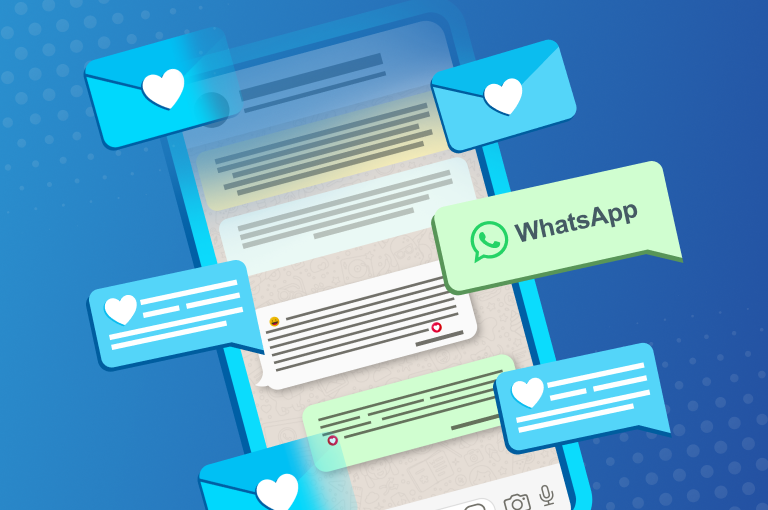
WhatsApp: the star channel for eCommerce
WhatsApp is already part of your customers’ everyday lives.
When we’re talking about more than 2 billion active users and the most widely used messaging channel in over 180 countries, this is no hunch. Don’t you agree? Come on—you’ve probably checked your WhatsApp more than once since you started reading this article.
In fact, in 2025 alone, its adoption in eCommerce grew by 66% compared to the previous year. This isn’t a passing trend—it’s a clear shift in behavior. And when habits change, your strategies should too.
From the customer’s point of view, WhatsApp is close and familiar. It’s not an inbox filled with commercial messages, but a space for conversation. That’s why, when a brand shows up there with a relevant, well-timed message, the impact is different: it feels more human, more direct, and much less intrusive.
For marketing teams, this goldmine of a channel makes it possible to communicate quickly and efficiently, without massive productions or endless processes. No hours of layout work or complex creatives needed: a well-thought-out message can be launched in minutes and reach the customer exactly when they’re most receptive.
That combination of closeness for users and agility for brands is what’s turning WhatsApp into the star channel for eCommerce. A channel that’s especially powerful at key moments of the customer journey, where timing, clarity, and relevance are everything.
And if you’re now wondering how to put all this into practice, don’t worry: in the next section, we’ll dive into concrete strategies to start making the most of it.
What strategies to implement in your eCommerce
Not sure where to start? Let’s get practical.
Guiding customers to their first purchase
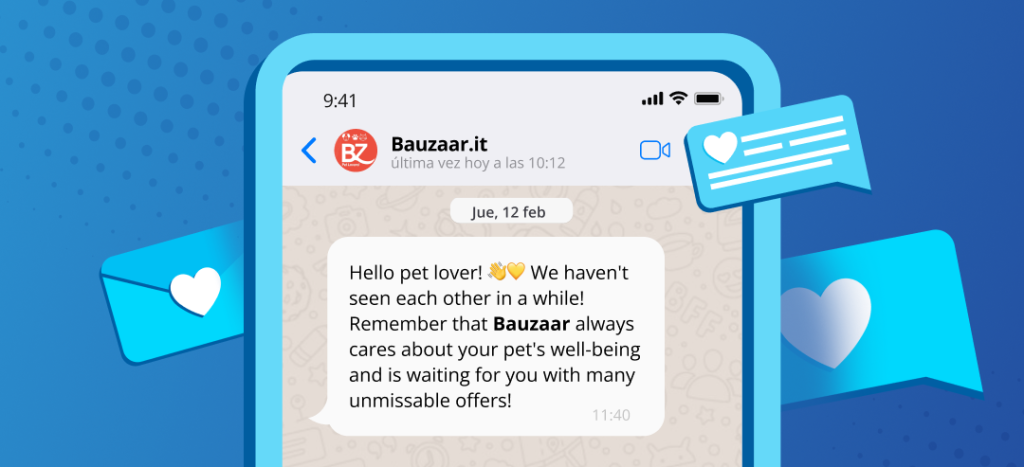
If you want to try something new and move beyond the classic welcome email, WhatsApp is a powerful entry point to kick off the relationship. Some online stores, like Bauzaar, use it as the first touchpoint after subscription to welcome users in a much more personal way.
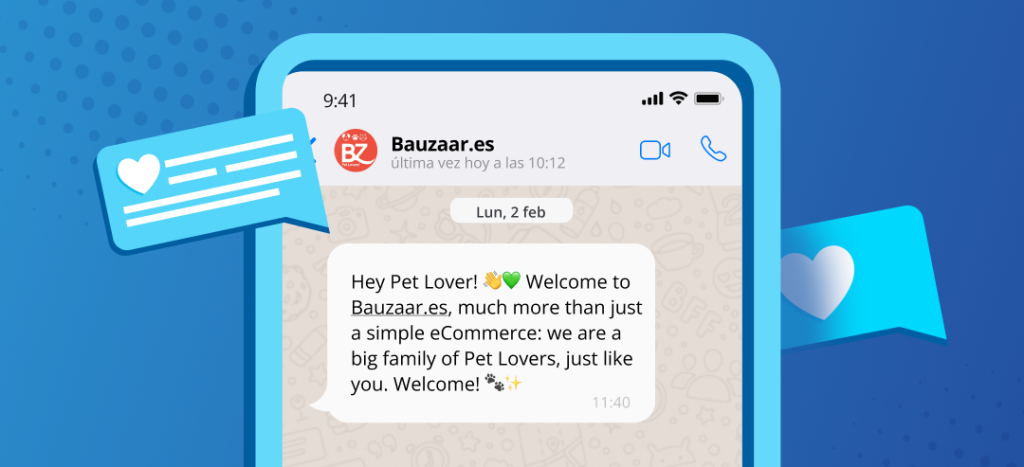
Not to push sales aggressively, but to introduce themselves, offer real help, and often include a small incentive for the first purchase. The message doesn’t feel like a promo campaign, but a conversation. And that completely changes the starting point of the relationship.
Recovering abandoned carts
The pattern is usually simple: first, an email reminder is sent, and if there’s no interaction, WhatsApp comes in as a second touchpoint. A short message, the forgotten product, a friendly tone, and perhaps a light incentive.
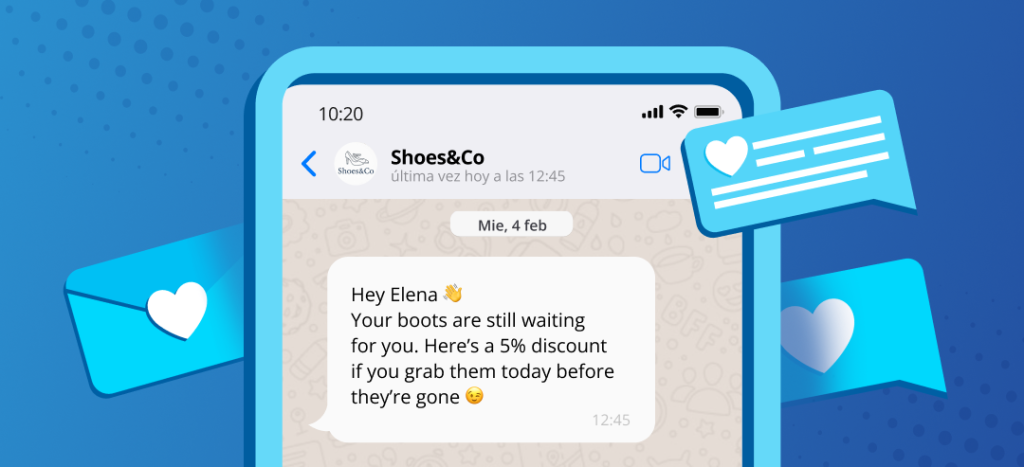
According to data from Spoki, this type of strategy can increase cart recovery by over 30%, precisely because it arrives quickly and in an environment where users are actually paying attention.
Offering customer support
WhatsApp can also be used for customer service. Answering questions about products, shipping, or returns through this channel feels natural for users and efficient for businesses.
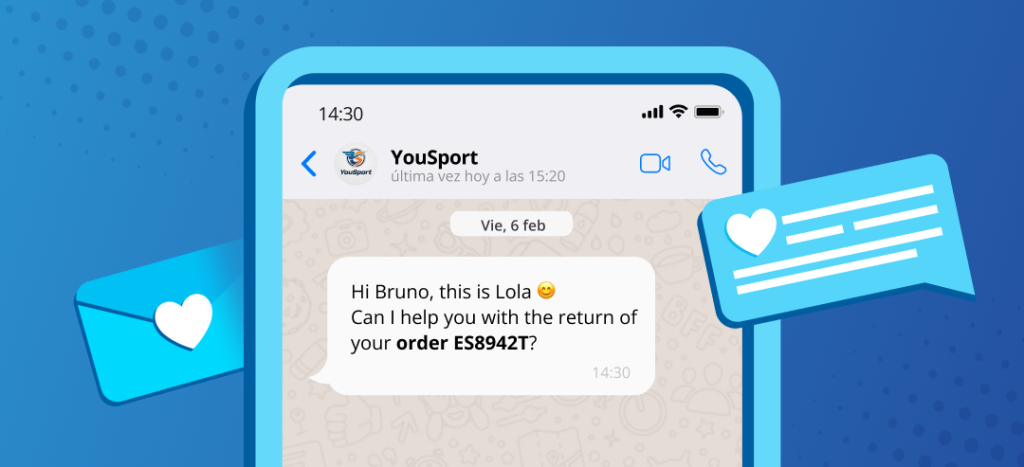
Fewer calls, fewer endless email threads, and less complexity. More clarity and faster answers when customers need them.
Taking care of VIP users
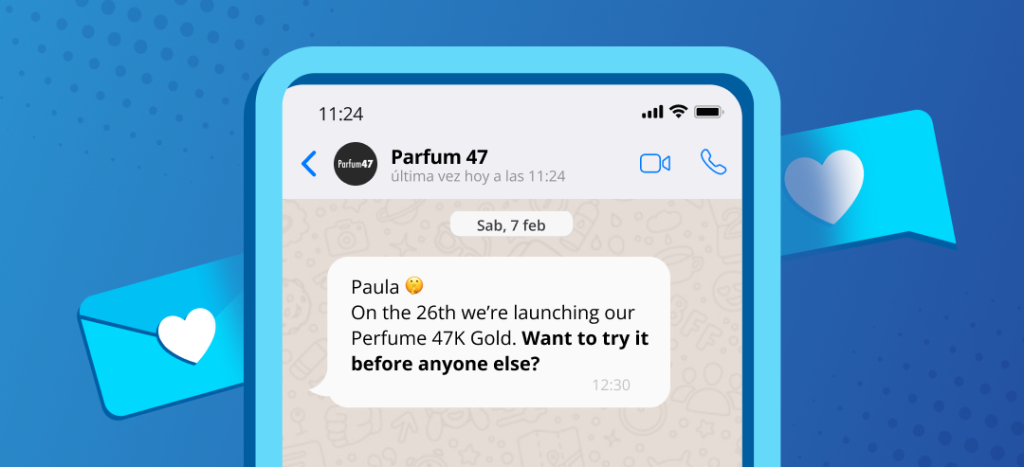
It’s also a very powerful channel for building exclusive relationships. During launches or key moments like sales, it can be activated only for VIP customers with a high RFM score. Early access, limited availability, or personalized messages create a real sense of privilege.
Increasing repeat purchases
Beyond immediate conversion, WhatsApp plays a key role in retention. At Bauzaar, for example, the channel is also used after the first purchase to send personalized recommendations based on customer interests and to keep the relationship alive.
Because true loyalty is all about showing that the brand is still there even when there’s no urgent sale on the table.
Improving the shopping experience
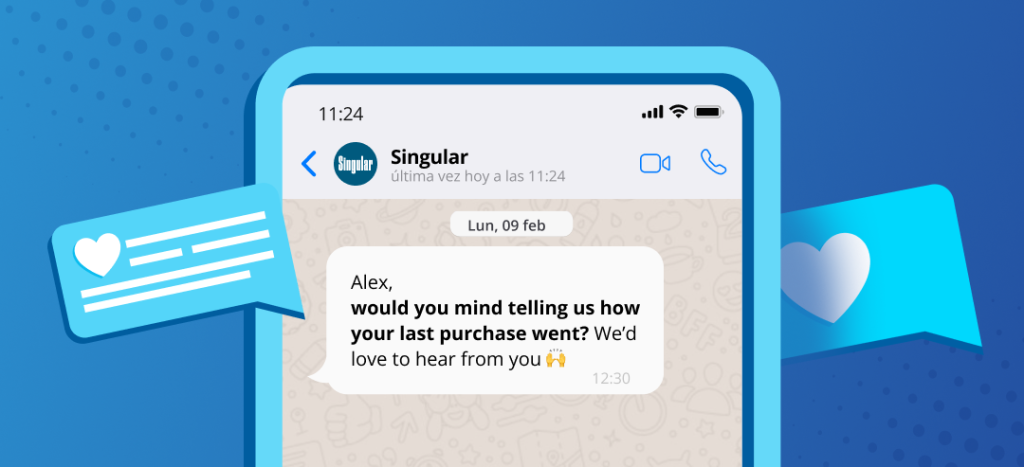
Finally, there’s the overall shopping experience. WhatsApp is ideal for collecting feedback in a simple way: short surveys, direct questions after delivery, or quick process validations. Users respond because it’s easy, and you get valuable insights without endless forms.
Across all these strategies, there’s one thing in common: WhatsApp works best when it’s used as a relationship channel, not as a promotions billboard.
WhatsApp in Connectif: frictionless omnichannel activation
Omnichannel gets complicated when each channel lives in its own tool. When launching something means jumping from platform to platform, strategy weakens and operations slow down.
That’s the advantage of working with WhatsApp inside an environment like Connectif, whether that’s through our integration with Spoki or directly with Meta. You can decide when it makes sense to activate it (and when it doesn’t), using the same customer data you already apply to email, web, push, and other channels.
In practice, that means less friction for you as a marketer and more continuity for the user. WhatsApp stops being a one-off experiment or an isolated channel and becomes a natural part of the omnichannel strategy you’re already building.
Ready to try something new?
It’s important to realize that channels don’t compete with each other, they complement each other. And exploring new ways to connect with customers isn’t about abandoning what works, but about not settling.
WhatsApp is already part of everyone’s daily life. Testing it thoughtfully, with context and a clear purpose aligned with your business, could be that small change that makes a big difference this year.